How to Declutter 'Just in Case' Items | Boston Professional Organizer
When you’re feeling overwhelmed by STUFF and you decide it’s time to declutter, you’re suddenly faced with a few different types of choices. First, you have the low-hanging fruit—items you immediately know can go in the trash, recycling, or donate pile. We love these ones because it's instant gratification!
Then there are the items that are harder to decide on. Sentimental and nostalgic items are a tough category, and I covered those in this past post (see “The Guilt Pile”). But items that prompt you to say, “What if I need this someday?” can be difficult too.
They don’t seem like a big problem, but they add up quickly.
So let's try a quick experiment. Imagine walking through your home and pulling out every single thing you're keeping "just in case." (Or, if you can’t think of anything, then actually walk around your home and see what you find.)
Things like:
Sheets for beds you no longer own
Old T-shirts or worn-out towels saved “for the dog” or “for rags” or "for painting" (enough for 19 dogs, 32 houses, and 41 painting projects)
Shoes that hurt but are "too nice to get rid of"
Mystery cords and chargers for phones or devices you no longer own
The old coffee maker (in case the new one breaks)
A second set of dishes
Old TVs (for the basement someday)
Empty boxes (you never know when you’ll need a good box)
Now picture all of it in one spot.
Would it fit on your dining room table? Your bed? Or would it overflow the guest room?
That looming pile has a name: WIINIS, aka "What If I Need It Syndrome.” (Also known as JICC, “Just In Case Clutter,” or, as I like to call it, the Maybe Mountain.)
But it’s nothing to beat yourself up about! Everyone has a pile like this, and it’s usually because you’re resourceful and practical. I'll admit, I’ve been known to stash and hoard art supplies like nobody’s business. Pobody’s nerfect!
Now that we have a visual, we’re going to take a deeper look at what this pile is costing you and how you can let some of it go.
Why “Just In Case Clutter” Is So Tricky
Before we can change our habits and behavior, it helps to understand where they’re coming from. And keeping excess items like those mentioned above is definitely a learned behavior. We weren’t born thinking, “I’d better keep these soy sauce take-out packets in case I need them someday when the bottle runs out.”
So what influences our choice to keep these kinds of items? Here are a few common reasons.
"I paid good money for that."
Ahhh, the dreaded feeling of spending money on something we later realize we rarely (if ever) use. It happens to the best of us, so don’t be too hard on yourself. In this case, letting go can feel like admitting the purchase was a mistake, so we keep it to avoid that little sting of regret. (Spoiler: we'll talk about why that math doesn't add up in a minute.)
"We didn't waste things growing up."
As kids, most of us learned not to waste things, but some more than others. And we all have lines we won’t cross. I have a friend who eats leftover soggy salad because she “doesn’t want it to go to waste.” That’s a line I won’t cross: no soggy salad for me. lol We should all be more mindful about waste, but if something is never used and you’re just keeping it so it ‘doesn’t go to waste,’ then I have news for you…it’s still waste, but you’re storing it in your home instead of letting it go.
"Someday I'll..."
This is one we can ALL relate to. The pile of clothes you keep meaning to patch, the photos you’ll finally put into albums, or the bread maker for the fresh loaves you’ll make every weekend…someday.
"I'm too tired to decide."
Decision fatigue is real — in fact, I shared a post about it a while back! We have so much going on in our lives these days, and when you're worn out, "keep" feels like the safe default, so the pile grows one tired decision at a time.
And when does the ‘what if I need it someday’ pile loom extra large? When all four of these thoughts are running through your mind at once. So let’s look at how these items weigh you down beyond just the space they take up in your home.
What That Pile Is Really Costing You
Ready for a plot twist? We default to keeping items for “just in case” because it feels like it saves us money. But most of the time, it quietly costs money instead.
Square Footage Isn't Free:
Every square foot of your home is part of your rent or mortgage. The linen closet, kitchen cupboards, or garage shelves holding "maybes" are spaces you pay for every month.
And when you picture your dream home, does that include piles of stuff you never use? Probably not. But you’re paying for it anyway.
Think of it like this. If your home costs $2,000 a month and a full closet is about 5% of your space, you’re spending $100 a month to store whatever’s inside. Multiply that by all the closets…garage…attic…and it adds up fast.
The Re-buy It Irony
When the “what if I need it” item is buried beneath other clutter, you can't find it when the “just in case” moment finally comes, so you end up buying another one instead. Now you own two (or five, or seven), and the pile grows.
The Storage-Unit Spiral
For some families, the pile outgrows the house and moves into a monthly storage unit, meaning you pay rent twice: once for the space at home and once for the overflow. This often happens when the family goes through a life change like a new baby, someone moving off to college (but they might come back!), or divorce. But when you add up all the monthly storage unit payments, you’ll see how much you’ve spent on extras.
The Money Is Already Spent
Instead of feeling more guilt over everything we just covered, remind yourself you’re only human. We all do this at one time or another.
And now? What’s done is done. The money left your wallet the day you bought the item. Keeping it doesn't bring your money back; letting it go just stops the ongoing literal cost in space and figurative cost in stress and overwhelm.
A Quick Word on "Insurance"
"Just in case" can feel like an insurance policy. Some things are worth paying insurance premiums on, like your family’s home and their health. Other items (like that chair in the attic that needs new upholstery or the second crockpot gathering dust) don’t require insurance, and most of the time, they never get used, so you’re paying the premium in space. Live a little. Take the gamble. Let it go.
Shrink Your Pile in 5 Minutes
Now you understand how you collected all this extra stuff, so it’s time to take some action, too.
You don't have to tackle everything today. Start small and start noticing the items around your home. When you come across something you’re saving for “just in case”, do the following.
Start With the Easy Stuff
Begin with low-stakes items or duplicates before tackling anything sentimental. Seeing progress will help you build momentum.
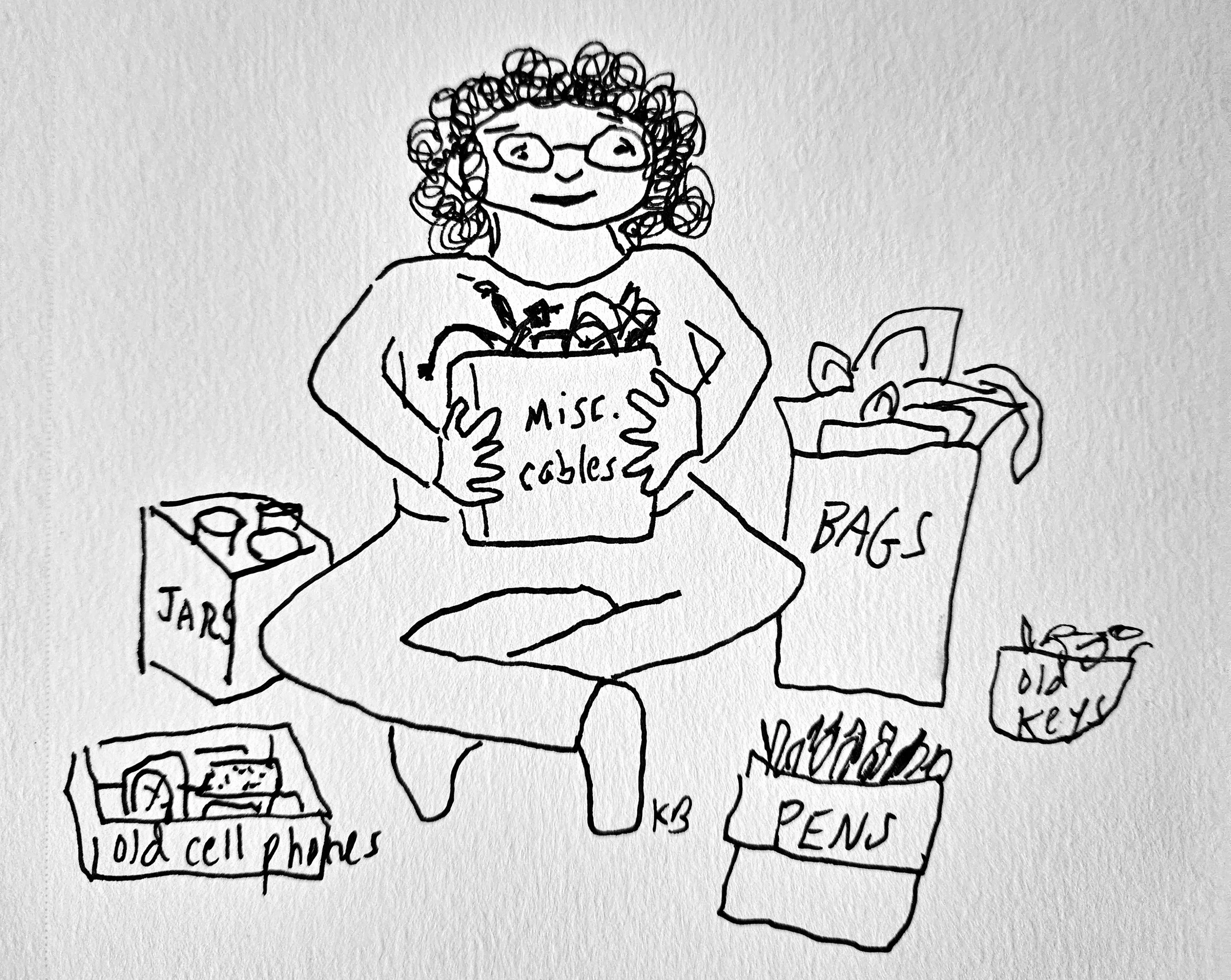
Here are some examples of common household WIINIS items.
Cords
Mugs (you don’t need 27)
Tote bags (you don’t need 27)
Takeout containers
Condiment packets
Glass jars (pasta sauce, salsa, pickles)
Business cards from people you don't remember
Duplicate gadgets: three can openers, four spatulas
Old cell phones
Loose keys to who-knows-what
Instruction manuals for appliances you've already replaced
Dried-out pens and highlighters
Spare buttons in little plastic bags
Ask Yourself a Few Questions:
When did I last use it?
If I ever needed it, could I borrow it or replace it easily?
What's the realistic worst case if I didn't have it?
Could I replace in under 20 minutes for less than $20?
When you really think about it, most "worst cases" are a mild inconvenience, not a crisis. Instead of having a pile of 20 boxes to choose from in your garage when you need to ship that return, you’ll grab one from work. If your can opener breaks and you no longer have a backup, you’ll ask the neighbor to borrow one until you can get to the store.
A Designated Place
Choose an area for all ‘what if I need it’ items instead of letting them take over the whole house. Choose one bin or one shelf as the official "just in case" spot. When it's full, something has to leave before something new comes in. The container sets the limit, so you don't have to argue with yourself. (Because let’s face it, we all argue with ourselves.)
How a Professional Organizer Helps with WIINIS
When my clients hire me to help them at home, it’s often because they’ve tried to get organized but they’ve never been able to see it through to the end. One of the most common reasons is how tiring it can be to do this on your own.
You can make much faster progress decluttering when I’m by your side helping you process all the decisions. Remember, it took years and years to accumulate your belongings; it’s gonna take time to get through it all, and it’s okay to ask for support when you need it.
You’re in Charge
No matter what, you call the shots. I’ll never decide for you or toss things behind your back. I ask the questions that make your own decisions feel easier.
And while you make the calls, I bring the perspective. I've seen a lot of "just in case" items, and I’ve worked in so many homes that we generally know what people actually need vs. what sits untouched for years. This helps take out the guesswork.
No Judgment
I really mean it when I say I’ve seen it all. And because I love what we do, I’m not here to criticize your space. Organizing is a learned skill, and some people learn it earlier than others! Hearing "that's really common" goes a long way, and I can reassure you that you’re not the only one experiencing this kind of overwhelm.
Finding Good Homes for Your Things
I avoid the landfill as much as possible, and letting go feels a lot easier when it means passing items on to someone who can use them. I can help you with donations, resale, buy-nothing groups, specialty drop-offs, etc.
Make Your Home Worth the Mortgage
For some people, just-in-case clutter is part of a bigger, long-term pattern. If clutter has felt like a constant struggle for as long as you can remember, and nothing you've tried seems to stick, you're not failing. You might be dealing with chronic disorganization, and the Institute for Challenging Disorganization (ICD) has wonderful resources.
Wherever you land, the goal is the same — and it isn't an empty house. It's a home you love to spend time in, a space that brings you peace and joy, not stress and chaos.
As a professional organizer, I’ve seen repeatedly that this goal usually requires fewer belongings, but it doesn’t mean stark minimalism. Picture the home you want, the way it feels, and see how your stuff fits into that image.
Then, circle back to the pile of ‘just in case’ items you pictured at the beginning of this post. How does it fit into your dream home? What would happen if you could let a lot of it go? What would you do with the extra space? Maybe you’d have a beautiful guest room that's actually for guests, a garage with a car in it, or a closet that looks like a boutique.
You get to decide how your home looks and feels.
So if your 'someday' pile is taking up prime real estate and feels completely overwhelming, let's work on it together. Contact me to find out how easy it is to get started.
Happy Organizing!
Katrine
Resources:
Why We Keep, Toss, and Pile: The Neurobiology Behind Our Stuff
How to Let Go of the “Just in Case” Mindset
“Just in case is the antithesis of making a decision.”
https://www.minimaonline.com/journal/just-in-case
How to Declutter Just in Case Items
https://www.thespruce.com/how-to-declutter-just-in-case-items-12113210